
Facial Care Is Four Formulas, Not One Category
A face range is a cleanser, a toner, a serum and a cream — four physical systems with four different failure modes. A cleanser is judged on foam, rinse feel and the tightness ten minutes later. A serum is judged on clarity, dropper behaviour and how quickly it disappears into skin. A cream is judged on structure: whether the emulsion still holds at month twelve, whether the jar shows syneresis. Briefing all four as one project with one price target is the most common reason a launch slips by a quarter.
Each system has a small number of parameters that decide the outcome, and once those are on the table, the conversation with a private label face cream manufacturer becomes technical instead of hopeful.
What the Factory Cannot Guess
Four decisions belong to the brand, not the plant:
- Skin type and claim. A barrier cream for reactive skin and a brightening cream for oily skin are not the same emulsion plus fragrance. The claim dictates the active load, the preservative strategy and the pH window.
- Price band. This sets the packaging budget, and packaging usually costs more than the fill. A 50 ml airless bottle can cost several times what the cream inside it costs to make.
- Launch market. The EU, the US, the Gulf and China ask for different documentation and, on some ingredients, different restriction lists.
- Format. Jar, tube, airless pump or dropper bottle. Each one changes preservative exposure, viscosity target and filling speed.
Write those four down before sampling starts. A cosmetic company that arrives with a reference product and a price target moves through development in two rounds; one that arrives with “something hydrating” usually needs five.
Anatomy of a Face Cream
Most face creams are oil-in-water emulsions, typically 15–30% oil phase, 60–75% water phase, 3–6% emulsifier system, and the remainder actives, humectants, thickener and preservative. The oil phase carries emollients and most of the sensory story; the water phase carries glycerin and the water-soluble actives. The emulsifier pair decides whether the result reads as a lotion or a balm on the finger.
Thickeners matter more than the label suggests: a carbomer or an acrylate gives the yield value that makes a cream look cut in the jar and hold its shape when scooped.
Process: Temperature, Shear, Cooling Rate
The formula is only half of the product. The other half is what the kettle does to it.
- Heat both phases to 75–80°C. The oil phase must be fully clear and every water-phase solid fully dissolved before they meet. Undissolved thickener becomes a grain you cannot grind out later.
- Homogenise at the point of emulsification. Droplet size is set in the first minutes. Under-shear gives a cream that looks fine and splits in three weeks; over-shear whips in air and makes fill weight wander.
- Cool slowly under low sweep. A fast cool locks in a metastable structure that stiffens further in the jar. This is usually where “it was perfect in the lab” comes from.
- Add heat-sensitive actives and preservative below 40°C. Above that, vitamin C oxidises, some peptides hydrolyse, and volatile components leave the batch.
Viscosity is read after 24 hours, not at the kettle. A cream that measures 40,000 cP hot will read differently after a night’s rest, and differently again after two weeks at 45°C.
Cleansers and Serums Obey Different Rules
A facial cleanser is a surfactant system. Amino-acid surfactants such as sodium cocoyl glycinate give a creamy, low-stripping lather; a conventional SLES system gives volume at a lower cost per unit. The number that decides user perception, though, is pH. Around 5.5 matches skin and keeps the after-feel soft, while a pH near 9 leaves the tight, squeaky sensation much of the market now reads as damage. That single figure is why a private label facial cleanser manufacturer will ask about skin type before quoting a price.
Serums are the opposite problem: low viscosity, high active load, and very little room to hide instability. A 10% niacinamide serum needs the right humectant balance to stay clear; a vitamin C serum at pH 3 needs chelation and an opaque or airless pack to survive its own shelf life.
Actives That Fail in the Jar Instead of on the Skin
Retinol, vitamin C, azelaic acid and most probiotic systems have a narrow window between “stable in the beaker” and “still active at month twelve”. Three practical consequences:
- Encapsulation costs money but buys time. A coated retinol withstands heat and light far better than the free form, at a higher cost per kilo.
- Packaging is part of the formula. An airless pump or a barrier tube limits oxygen ingress; a wide-mouth jar invites it.
- Colour change is not automatically failure. Some actives shift hue while keeping their activity, so testing has to measure the active rather than the appearance.
Preservation, Compatibility and the Tests That Decide
Every water-containing formula needs a preservative system that passes a challenge test on the real formula, not a model. Efficacy depends on pH, on the oil–water partition, and on how much preservative the packaging adsorbs.
Three test streams run in parallel: accelerated stability at elevated temperature, freeze–thaw cycling, and pack compatibility — leakage, pump prime, label adhesion and wiper-seal behaviour in an airless unit.
Filling Inside a 100,000-Class Cleanroom
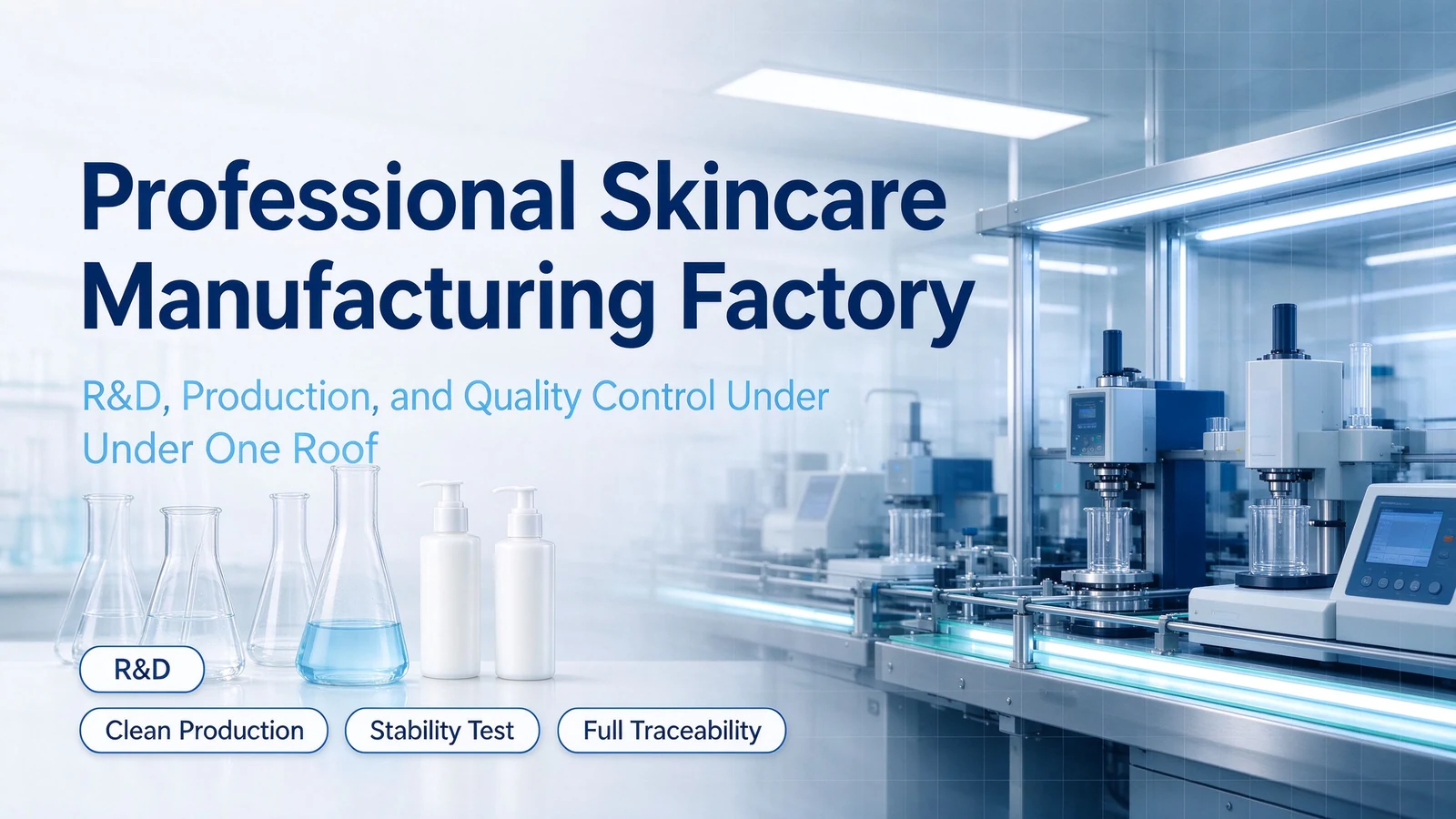
Our Guangzhou factory runs a 100,000-class cleanroom with more than fifty filling lines, because facial care needs several at once: a piston filler for viscous cream, a vacuum filler for jars, a peristaltic line for serum. Filling temperature matters. A cream filled at 35°C sets differently from one filled at 22°C, and the difference shows up as a dip at the jar shoulder. Weight checks run at the start, middle and end of every batch; the retained sample is your evidence if a market complains.
MOQ, Sampling and the Calendar
The numbers that decide whether a launch is viable:
- 1,000 pieces on a stock formula — the fastest and cheapest route to market.
- 3,000+ pieces when packaging is customised, because tooling and print runs carry their own minimums.
- 7–10 days per sampling round, and budget for two rounds.
- 25–35 days for bulk production after approval, before transit.
A four-SKU face range therefore lands roughly three to four months from brief to warehouse. Buyers who compare private label face products wholesale quotes without checking those four figures are comparing incomparable things.
Documentation Travels With the Goods
Certification is not a badge on a homepage; it is a set of documents customs and retailers will ask for. We hold GMPC, ISO 22716, ISO 9001, Halal and FDA registration, and the documentation team prepares CPSR, CPNP notifications, FDA facility information and GCC files for the Gulf. A company shipping into more than sixty export markets has already been through most of those arguments.
How to Shortlist a Supplier
When you are comparing the best private label facial care options, ask for five things: the formula sheet with percentages, the challenge test report for that exact formula, the stability protocol and its intervals, the filling line used for your pack format, and a named contact who answers technical questions without an interpreter. A supplier who answers all five in one call is a partner. One who sends a catalogue is a broker.
Ten thousand mature formulas and six patents do not make a brand. They shorten the distance between a brief and a shelf-ready beauty product, and that distance is what a manufacturer is really selling.
We invite you to explore our capabilities and discuss your next product line.
You can reach us directly via WhatsApp +86 18924103061
Email laeyo@cosmeticoemlab.com
Website https://cosmeticoemlab.com/