
Why a Men's Range Is Never a Repackaged Women's Range
A men's grooming range looks simple on a shelf: a wash, a shave product, an oil, a moisturiser. On the bench it is four different physical systems, and each one fails for a different reason. A wash that gels nicely in the bottle can thin out in a warehouse at 40 °C. A shave gel that feels slick in the lab can drag on a three-day beard. A beard oil that smells clean on day one can turn before the second production run.
This is what a cosmetic contract manufacturer actually controls in a men's line - surfactant chemistry, polymer glide, carrier oil selection and fragrance dose - and what low MOQ really covers when you launch a small business range rather than a twelve-SKU catalogue.
Four Products, Four Physical Systems
Most first men's ranges start with four items: a daily face wash, a shave gel or cream, a beard oil, and a post-shave moisturiser. Each belongs to a different formulation class, and that class decides your filling line, your component and your stability protocol long before the marketing story is settled.
- Face wash - a surfactant system, salt or polymer thickened
- Shave gel - a thickened gel where clarity rules
- Beard oil - an anhydrous blend that oxidises
- Moisturiser - an emulsion balancing stability and feel
Face Wash: Surfactant Load, pH Window, Salt Curve
A men's cleanser is usually asked to degrease more than a face wash built for drier skin, which pushes active matter upward. The trade-off appears after shaving, when a stripped barrier stings. Most men's washes land between 8 % and 14 % total surfactant active, built on a primary anionic such as SLES or an amino acid surfactant like sodium cocoyl glycinate, with a betaine or glucoside to soften the after-feel.
Viscosity is where production problems start. Salt-thickened systems sit on a curve: sodium chloride lifts viscosity to a peak, then thins it sharply. A batch that overshoots cannot be rescued by more salt - it has to be diluted and rebuilt. Polymer-thickened systems cost more per kilogram but tolerate electrolyte from fragrance and actives far better, which matters once you add salicylic acid or zinc PCA.
pH should sit near 5.0 to 5.5. Above 6 the wash feels slippery and strips; below 4.5 some amino acid surfactants fall out of solution and the gel clouds.
Shave Gel and Shave Cream: Where Glide Comes From
A clear shave gel is a neutralised carbomer or VP/VA system at roughly 0.4 % to 0.8 % polymer, with glycerin at 3 % to 8 % for slip and a water-soluble lubricant to cut blade drag. Clarity is the constraint: any incompatibility between polymer, fragrance and preservative reads as haze, and haze is a reject at the filling head.
Shave cream takes the opposite route - a soap or surfactant base with stearic acid for cushion. It is more forgiving on formula robustness and less forgiving on temperature, because the foam body depends on a crystalline network that forms during cooling.
Beard Oil: Carrier Viscosity and the Oxidation Clock
Beard oil is the easiest formula to write and the easiest to ruin. Jojoba, squalane, argan and caprylic/capric triglyceride are the usual carriers, blended to a viscosity that reads as absorbed rather than sitting on the skin. Jojoba is technically a wax ester and resists rancidity well; argan brings a heavier feel and a shorter life; caprylic/capric triglyceride is light and stable but adds little conditioning.
Any blend with a meaningful polyunsaturated fraction needs an antioxidant - tocopherol at 0.1 % to 0.5 % is standard - plus packaging that limits headspace. A dropper that admits air on every use oxidises faster than sealed stability samples suggest, which is why component and formula have to be approved together.
Post-Shave and Matte Moisturiser: The Comfort Problem
Post-shave products carry the highest stinging risk in the range. Alcohol at 10 % or more gives a fast dry-down and a sharp sensation on freshly exfoliated skin; allantoin at 0.2 % to 0.5 % and panthenol at 1 % to 2 % are the usual comfort agents. Menthol is the difficult one: at 0.1 % it reads as cooling, at 0.3 % it reads as burning.
A matte claim usually means a low oil phase plus starch, silica or a polymeric mattifier. Those ingredients absorb sebum and thicken the emulsion at once, so the emulsifier pair is chosen for the final texture rather than the base, and a formula that passes at pilot scale can still fail on a 500 kg batch.
Fragrance Load, the Usual Culprit
Men's lines lean on fragrance harder than most face care. In a leave-on cosmetic product, typical dosing is 0.2 % to 0.5 %; in a wash, 0.5 % to 1.0 %. Above that, allergen declaration becomes the limiting factor in the EU, where the 26 declarable allergens must appear on pack once they pass their labelling thresholds. Our fragrance work runs across 13 lines supplied by French and Chinese houses, and each oil arrives with an IFRA certificate and a full allergen breakdown - the document set that decides whether your label clears review.
What Low MOQ Actually Covers
The phrase low MOQ cosmetic manufacturer gets used loosely in this industry, so it is worth being precise about which cost is minimised.
- Stock formula, standard component - from 1,000 pcs per SKU
- Custom packaging - 3,000 pcs and above, because components are tooled or imported per order
- Sampling - 7 to 10 days per round, usually two or three rounds to approval
- Bulk production - 25 to 35 days after approval and component arrival, 35 to 45 days for fragrance-led lines
What does not shrink is documentation. A 1,000-piece order still needs a CPSR, a stability file and a label review, so fixed cost dominates a first run and unit cost falls steeply at 5,000 and 10,000 pieces. A cosmetics manufacturing company quoting the same unit price at 1,000 and at 10,000 is normally quoting a stock item it has already made.
Plant, Certificates and Export Paperwork
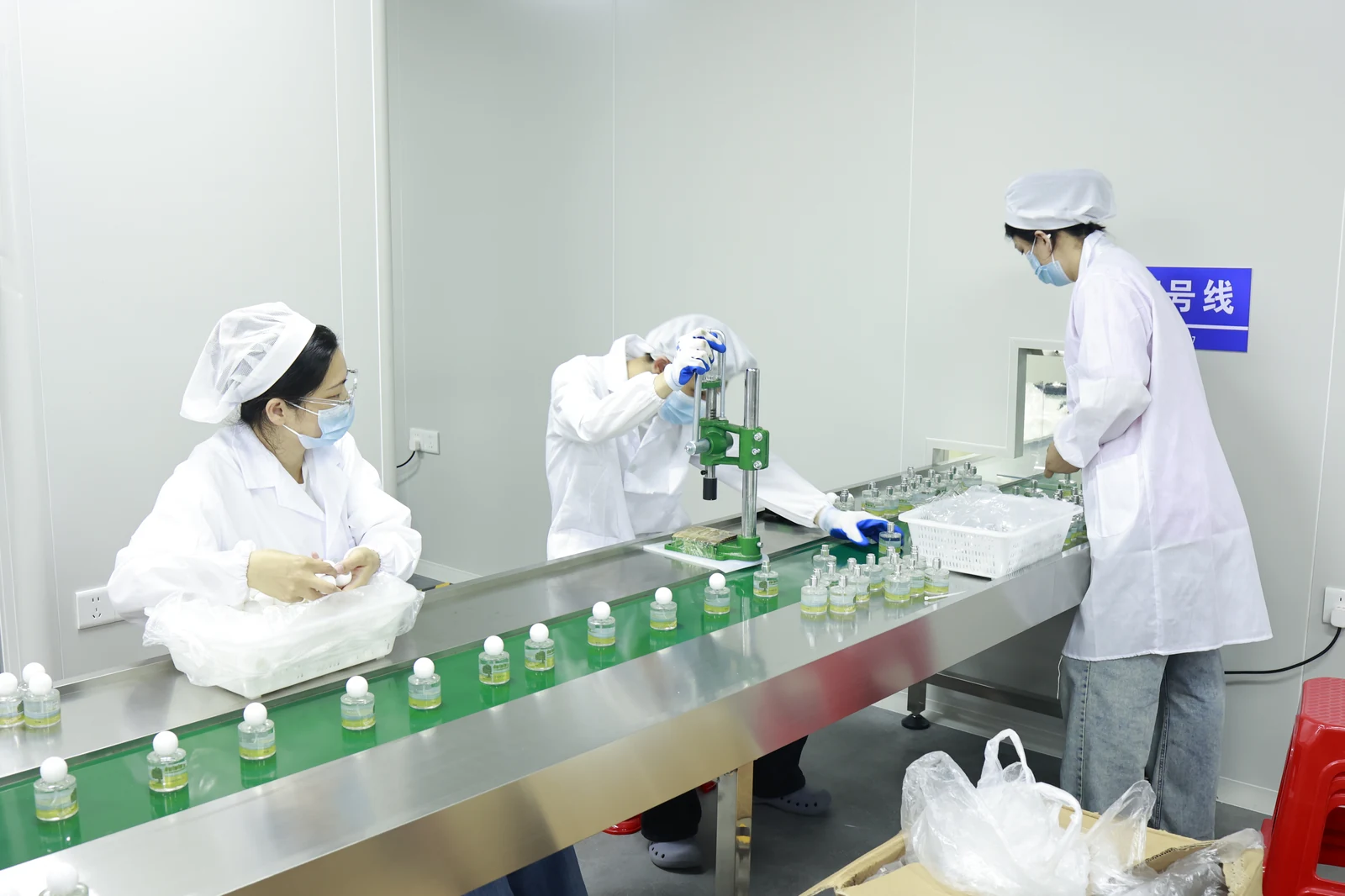
A beauty product manufacturer shipping into the EU, the US and the Gulf works to three documentation standards at once. Our site in Huadu, Guangzhou covers 10,000 m² with a 100,000-class cleanroom and more than 50 filling lines, operating under GMPC, ISO 22716 and ISO 9001, with Halal certification and FDA registration. The in-house lab holds over 10,000 stock formulas and 6 patents, which is what makes a 1,000-piece run on an existing base realistic instead of a favour.
For a first export order the practical set is CPSR from a qualified safety assessor, CPNP notification for the EU, FDA facility registration for the US, and Halal documentation wherever the claim sits on pack. We prepare these in-house for more than 60 markets, and a distributor in the Gulf will ask for the Halal file before anything else.
Five Questions to Ask Before You Sign
- Which base are you quoting? A named stock formula, or new development
- Where does the MOQ step change? Formula, component or carton
- What is the specification window? A viscosity and pH range, not a single number
- Who signs the CPSR? In-house or third party, and on what timeline
- What happens at 40 °C for three months? Ask for the accelerated protocol, not a promise
The right partner for a men's line is the one that can explain why your shave gel went cloudy, not simply the one with the lowest quote. A wash, a gel, an oil and a cream are four small problems; solved in the right order, they carry an eye serum or a scalp tonic later without a second development cycle.
We invite you to explore our capabilities and discuss your next product line.
You can reach us directly via WhatsApp +86 18924103061
Email laeyo@cosmeticoemlab.com
Website https://cosmeticoemlab.com/