
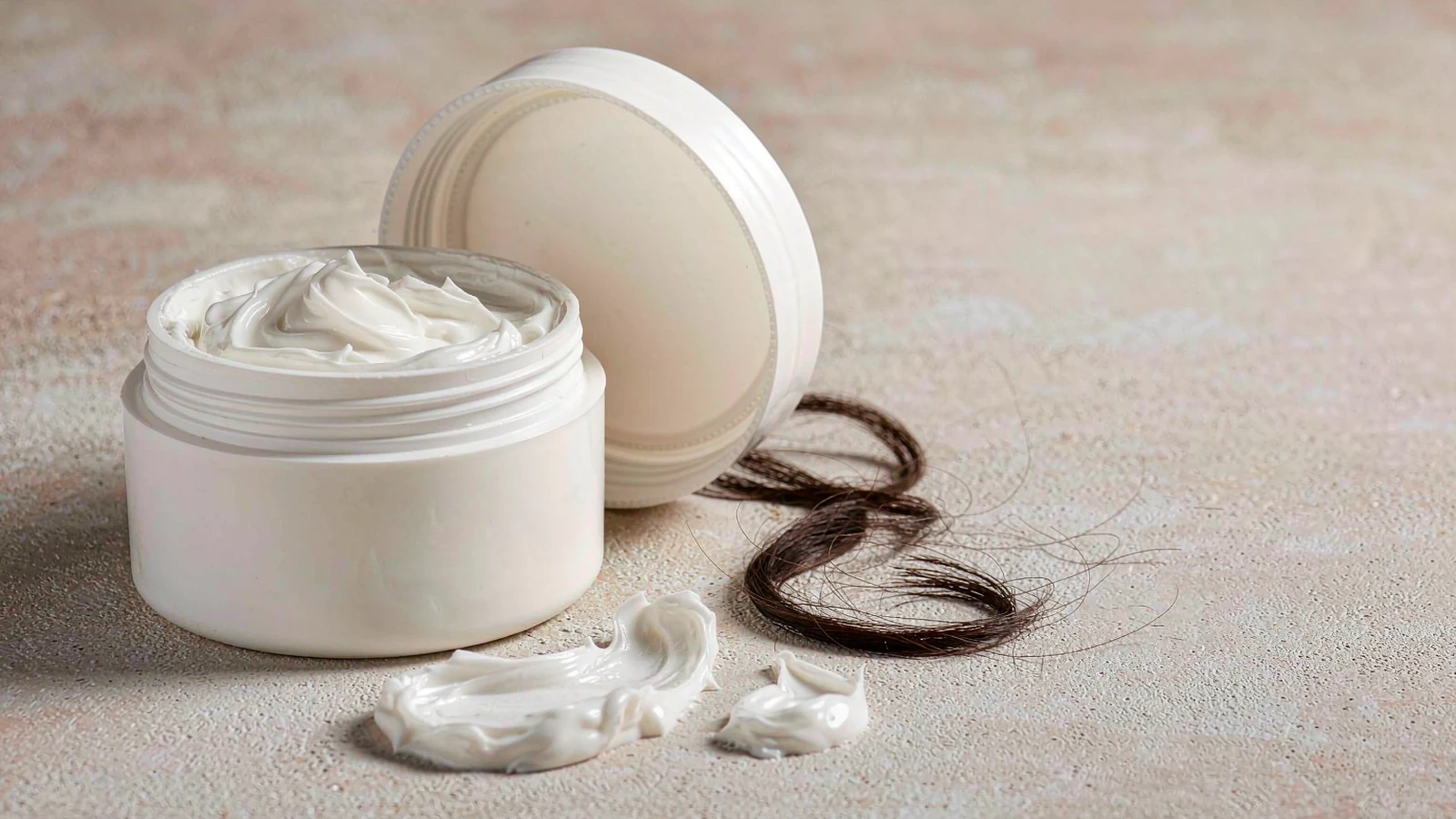
A rinse-off hair mask looks like a jar of thick cream, but the physics inside it is closer to a structured gel than to a lotion. That one difference explains most of the failures brands run into when they brief a factory: a mask that pours easily in the lab arrives at the filler too thin to stay on a strand, or so stiff that it will not come out of a 250 ml jar. The structure, not the fragrance, is what decides whether the product performs.
Why a Rinse-Off Mask Is Not a Thick Conditioner
A rinse-off conditioner is built around a light lamellar gel: 1–2% cationic surfactant, 2–4% fatty alcohol, water, and a little emollient. It is designed to spread fast, deposit, and rinse away in thirty seconds. A mask carries two to four times the oil phase, a higher cationic load, and usually a polymer or clay to build yield stress so the product stays where it is placed for five to ten minutes.
We treat the two as separate formulation families. A conditioner brief can normally be met from an existing platform; a mask brief usually needs a new gel network, because the emollient load changes the phase behaviour of the entire system.
The Gel Network: Fatty Alcohol and Cationic Surfactant
The backbone is a lamellar phase formed when a fatty alcohol and a cationic surfactant are melted together above 70 °C and cooled under controlled shear. Cetearyl alcohol at 4–8% with behentrimonium methosulfate or cetrimonium chloride at 1–3% is the usual starting point. The ratio matters more than the total: too much alcohol and the mask turns waxy and dulls the hair, too little and the network never sets, so the cream separates in the jar within weeks.
- Melt phase — 75–80 °C, held until the alcohol is fully clear
- Cooling — slow swept mixing through 55–45 °C, the window where the gel forms
- Actives — added below 40 °C, since proteins, amino acids and most botanicals will not survive the melt
Cooling rate is a process variable, not a footnote. A batch cooled too quickly in a jacketed tank can set with a grainy texture that no amount of homogenisation will repair.
Deposition Balance: Charge Density and Hair Type
Cationic surfactants work because damaged hair carries a negative surface charge. More charge density means more deposition, more slip and faster detangling, up to the point where the film turns heavy and hair looks flat. Fine hair saturates early; coarse or curly hair tolerates a much richer system.
That is why one mask formula rarely serves a whole range. When a cosmetics brand asks for a single hero product across hair types, we suggest building the richest version first and then diluting the emollient phase down for the fine-hair variant, holding the cationic level constant so the sensory story stays consistent.
pH Window and the Preservative It Forces
Cationic conditioning performs best between pH 3.5 and 4.5, where the surfactant is fully protonated. That acidic window immediately narrows the preservative list. Benzoic and sorbic acid only work at low pH and are weak against moulds alone; phenoxyethanol prefers 5–6 and needs a partner. Whatever combination is chosen has to be confirmed in a challenge test rather than copied from a supplier table, because a mask is a high-water, high-emollient product that moulds find comfortable.
Emollient Load, Silicones and the Weight Problem
The oil phase typically runs 5–12%: vegetable oils, fatty esters, and 1–3% of a dimethicone or an amodimethicone. Amino-functional silicones deposit selectively on damaged areas, which is genuinely useful, but they also accumulate on fine hair with repeated use. We screen the level on bleached swatches before locking the formula, since a panel verdict on undamaged hair will not reveal the difference.
Bond-Repair Chemistry: Where the Risk Sits
Systems that rebuild disulfide bonds sit in a different space from a conditioning mask. They need tight pH control, clear eye-contact warnings, and in some markets a different product classification. When a brief asks for repair language, we keep the bond chemistry in a dedicated step so it cannot disturb the pH of the gel network, and we hand the claim wording to the brand's regulatory adviser rather than writing it ourselves.
Who are the best private label hair care manufacturers?
The honest answer is that the best partner is the one that can explain its gel network, not the one with the longest client list. Four questions do most of the work:
- Do they build the lamellar phase themselves, or buy a base and stir fragrance into it?
- Can they show viscosity and pH data across a twelve-week accelerated run, not a single release test?
- Do they fill jars, tubes and sachets on the same site, or broker the filling out?
- Is the document pack — CPSR, CPNP, Halal, GCC — produced in house?
At our plant in Huadu, Guangzhou, China, the formulation lab sits in the same 10,000 m² building as the filling hall, which shortens the loop between a failed stability result and a corrected batch. As a beauty products manufacturer working with more than 300 brands across 60+ export markets, we have learned that the second question is the one that predicts trouble.
Where can I find private label wholesale hair products?
Wholesale hair products can mean two very different purchases: a stock formula from a catalogue with your label on the jar, or a formula developed for you. The first is faster and cheaper and works well for a test launch; the second is the only route to a product a competitor cannot copy in a month. Where to look depends on which of the two you actually need.
Ask any cosmetics factory the same four things: which formulas are genuinely in stock, what the true minimum is per SKU, whether the jar and cap are tooled or off-the-shelf, and how long a repeat order takes once the artwork is approved. In our case stock formulas start at 1,000 pcs, custom packaging runs from 3,000, sampling takes 7–10 days per round, and bulk production is 25–35 days after approval. Hair care is one of ten categories under our roof, alongside skin care and the other beauty products we produce.
Filling, Viscosity Drift and Twelve-Week Stability
A gel network keeps moving after it leaves the tank. Viscosity typically climbs for the first 48 hours, then settles; a product filled at the top of its range can be too stiff to dispense by the time it reaches a shelf in a warm market. We fill masks at the lower end and let the structure build in the jar, and we check for syneresis — a thin watery layer under the lid — at 4 °C, 25 °C and 40 °C over twelve weeks, plus freeze-thaw cycles for export routes. This is where a cosmetics factory without its own formulation lab tends to struggle: it can measure viscosity, but it cannot correct it.
MOQ, Sampling Calendar and the Real First-Order Cost
First-order cost is usually dominated by packaging, not by the formula. A custom jar needs tooling and a higher minimum; an off-the-shelf jar with a printed label lets a cosmetics brand start small and reinvest. Two or three sampling rounds are normal for a mask, because the sensory verdict on wet combing rarely matches the first attempt. Brands comparing a China quote with a local filler usually find the gap sits in packaging, not in chemistry. Planning for eight weeks from brief to bulk delivery is realistic; promising four is not.
We invite you to explore our capabilities and discuss your next product line.
You can reach us directly via WhatsApp +86 18924103061
Email laeyo@cosmeticoemlab.com
Website https://cosmeticoemlab.com/