
Why Infant Skin Rewrites the Formula Brief
Infant skin is not a smaller version of adult skin. The stratum corneum is thinner, the surface-area-to-body-weight ratio is several times higher, and the barrier is still maturing through the first two years. In practice, a wash that performs beautifully on adult skin can leave an infant tight and flushed after one bath. When a cosmetics brand asks us to open its own baby line, the brief changes in three places only: the surfactant blend, the preservative system, and the rinse residue. Everything else follows from those three.
Tear-Free Begins in the Surfactant Blend
No single ingredient makes a wash tear-free. Mildness is a property of the blend and of how little of it you can get away with.
- Primary surfactant. Sodium cocoyl isethionate or sodium lauroyl methyl isethionate as the backbone at 4–7% active gives dense foam with a low irritation profile.
- Boosters. Coco-glucoside or lauryl glucoside at 2–4% active softens the foam and reduces the sting of the primary.
- Amphoteric. Cocamidopropyl betaine at 2–3% active lifts foam volume and cuts the tight after-feel.
- Total active matter. Most baby washes land at 8–12%. Above 14% you are selling foam the parent did not ask for and paying for it in irritation.
Ethoxylated sulfates are not forbidden, but a brief that specifies SLES at 10% active is a brief for a family shampoo, not for a newborn.
pH, Solids and Viscosity: Three Numbers That Break a Baby Wash
pH is adjusted to 5.0–5.5 with citric or lactic acid after the batch drops below 45 °C, never before. Solids are held at 12–18% so the product pours from a 250 ml bottle without shaking. Viscosity targets 2,000–6,000 cP at 25 °C and is tuned with sodium chloride along the salt curve — and this is where first batches fail. Past the peak of that curve, more salt thins the batch instead of thickening it. Thickening by eye hands production a formula that separates on the truck.
Preservation on Skin That Is Already Compromised
Preservative choice is narrower here than in adult care. Phenoxyethanol is used up to 1.0%, sodium benzoate at 0.5% but only while pH stays below 5.5, and potassium sorbate at 0.6% for the same reason. Isothiazolinones have no place in a leave-on product for infants. Because benzoate and sorbate are pH-dependent, pH must be re-measured after preservation, not before. Preservative efficacy is normally demonstrated by a challenge test to ISO 11930 at an external laboratory; the brief should name that requirement from day one, because reformulating later costs a sampling round.
Baby Lotion: An Emulsion That Must Not Drift
A lotion is the second product in almost every baby range, and the one that quietly fails. As a private label moisturizer manufacturer we build these as oil-in-water emulsions with a 12–20% oil phase: caprylic/capric triglyceride for spread, petrolatum at 2–5% for occlusion, dimethicone at 1–2% to reduce tack. Glycerin at 3–5% carries the humectancy. Water and oil phases are brought to 75 °C separately, homogenised, then cooled under sweep agitation to 40 °C before the preservative goes in.
Target viscosity is 8,000–15,000 cP. The failure mode is drift: a lotion that reads 12,000 cP on day one and 8,000 cP at week eight will look thin in the bottle on shelf. A small xanthan or carbomer addition stabilises the network, and a 12-week check at three temperatures tells you whether it held. Freeze-thaw cycling is the second filter.
Diaper Cream and the Zinc Oxide Problem
Zinc oxide defines the category and dictates the plant. Loadings run from 10% to 40%. At the top of that range the slurry is dense, settles fast, and needs both a suspending agent and a slow sweep during filling. Zinc oxide slurries sit at pH 8–9, which rules out benzoate and sorbate entirely, so most high-load diaper creams are anhydrous petrolatum systems rather than emulsions. That choice then decides the filler: a thick paste needs a piston or drum filler, not the peristaltic pump used for the wash.
Fill Volumes and Components for a First Run
Standard baby range geometry is unglamorous and reliable: 200–250 ml for the wash, 200 ml for the lotion, 100–150 g for the cream. Those numbers are driven by component availability, not by marketing.
- Stock formula. 1,000 pcs minimum, sampling in 7–10 days per round.
- Custom packaging. 3,000 pcs and up, because the tooling has to be amortised.
- Bulk production. 25–35 days after sample approval and component arrival.
At 1,000 pieces, the component decides the calendar far more than the chemistry does. A pump out of stock in the right neck size delays a launch by weeks, so component confirmation belongs in week one.
How much does contract manufacturing cost?
Buyers ask this before anything else, and the honest answer is a structure rather than a number. Five blocks carry the cost: formula (stock library versus custom development), component (existing mould versus new tool), fill and packing labour at low volume, documentation and testing, and freight. At 1,000 pieces the per-unit price is dominated by the component and by setup amortisation — not by raw materials. The formula is usually the cheapest line in the project and the one buyers negotiate hardest.
What “No Minimum” Really Means at Factory Scale
Founders searching for organic private label skin care no minimum usually arrive at the same conclusion within a week: no plant runs a true zero minimum, because a batch is a batch and a 500 litre tank has a floor. Our floor is 1,000 pcs on in-stock formulas, which is low enough for a first container and high enough to keep a cleanroom run economical.
Organic is separate. An organic claim belongs to a certificate held by the brand and traceable through a specific supply chain. We formulate with naturally derived oils and document every input, but we will not print a certification we cannot trace.
Documentation Before the First Batch
Infant products attract more scrutiny than adult lines, and paperwork should be scoped at briefing stage, not after sample approval. A cosmetic product safety report is the baseline for the EU, with CPNP notification before placing on market. FDA registration, Halal documentation and GCC conformity cover the US, Gulf and Southeast Asia. Every declaration on pack has to match the formula version actually produced.
What to Put in the Brief
- The age band. Newborn, 0–3 years and kids are three different irritation budgets.
- The claim you intend to print. Tear-free, fragrance-free and organic each require a different evidence trail.
- Fill size and component. A stock 250 ml bottle changes the minimum order and the timeline.
- Target markets. This single line decides which documents you need and in what order.
If all four are settled, one sampling round is usually enough; if they are not, the budget goes on revisions instead of launch.
Choosing the Right Partner
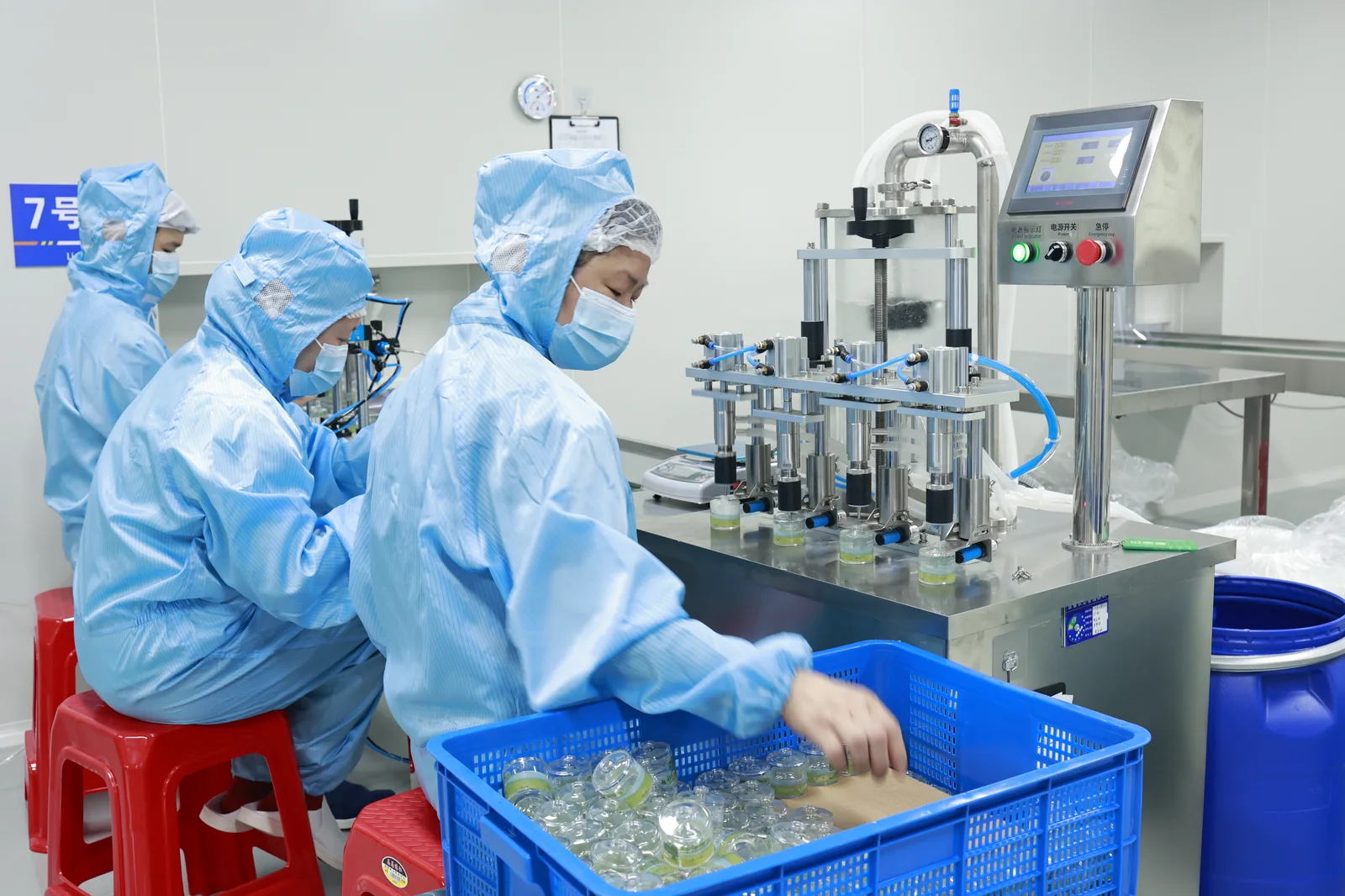
Our plant in Huadu, Guangzhou covers 10,000 m² with a 100,000-class cleanroom and more than 50 filling lines. A skincare factory of that size can run a 1,000-piece baby order beside volume production without parking it in a queue. The formulation library holds over 10,000 formulas and six patents, so a baby wash or lotion often starts from a proven base rather than a blank page. Certification covers GMPC, ISO 22716, ISO 9001, Halal and FDA registration, and the documentation team prepares CPSR, CPNP, FDA, Halal and GCC files for more than 60 export markets. As a skincare manufacturing company working with over 300 brands, we have learned that the difference between a smooth baby launch and an expensive one is decided before the first batch, not after.
We invite you to explore our capabilities and discuss your next product line.
You can reach us directly via WhatsApp +86 18924103061
Email laeyo@cosmeticoemlab.com
Website https://cosmeticoemlab.com/