
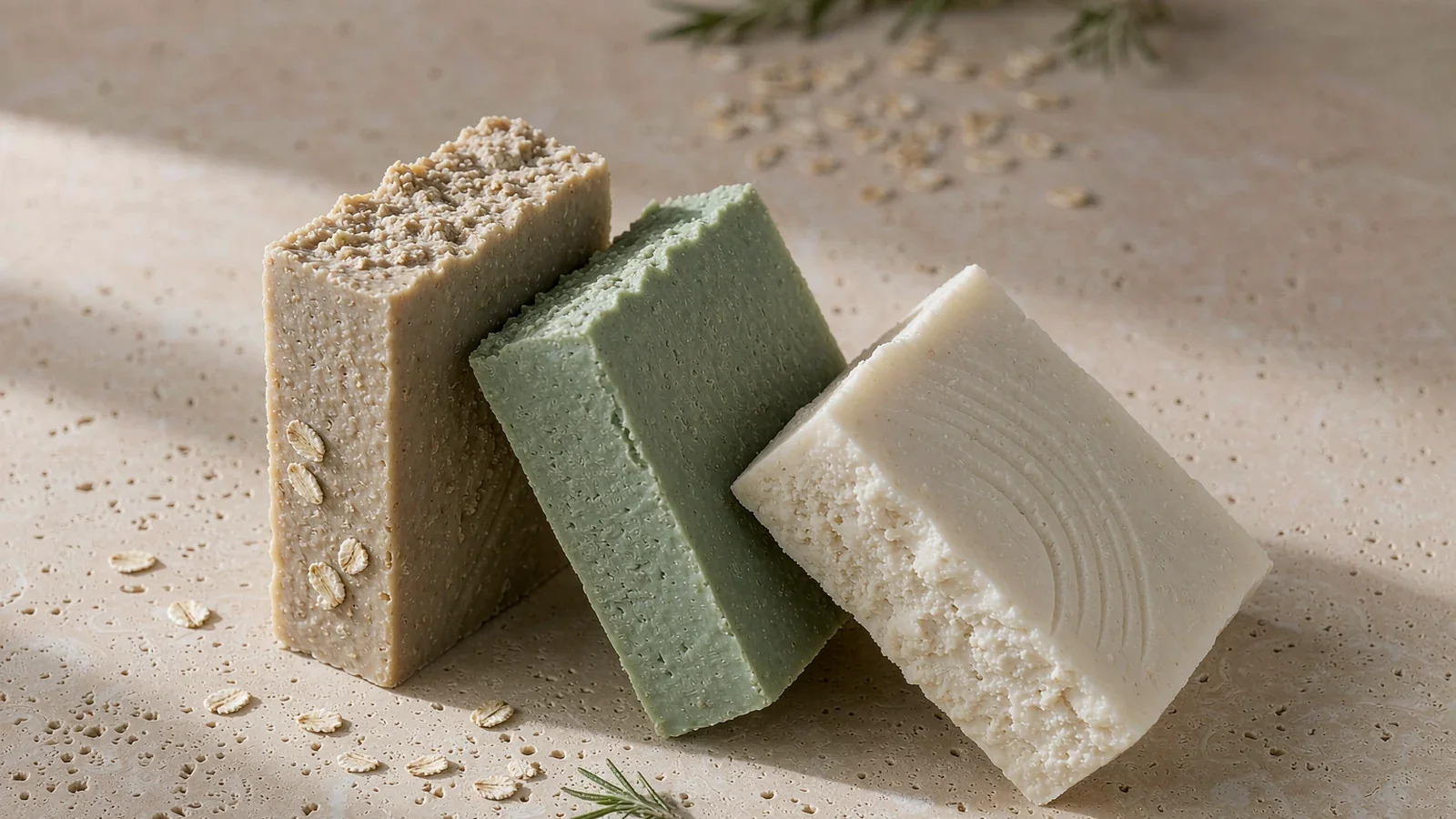
Why a Bar Is Not a Thickened Liquid
Most briefs arrive written for a liquid — a gel, a lotion, something that pours — and assume a bar is the same formula with less water. In a solid bar, water is an impurity rather than a carrier, the surfactant is often crystalline at room temperature, and the object keeps changing for weeks after it has left the line. That assumption is behind most first batches that fail weight checks or discolour in the carton.
Saponified Bars Begin With a Lye Calculation
True soap is a salt, not a mixture. Every oil has a saponification value — the milligrams of potassium hydroxide needed to saponify one gram — and the formula multiplies each oil's weight by that value, then converts to sodium hydroxide. Two decisions sit on top: the lye discount, which becomes superfat, and the water ratio.
- Superfat. Body bars run 3–8%; a 5% discount leaves enough free fatty acid for a creamy lather without pushing the bar toward rancidity.
- Water. A 33% water-to-oil ratio, or a lye concentration near 30%, is the workable middle. Wetter batter pours easily but shrinks more in cure.
- Temperature. Cold-process batter is emulsified at 45–55 °C and poured at light trace. Hotter process speeds saponification but darkens fragile oils.
Because the reaction continues inside the mould, the batch is not finished when it is unmoulded; a bar schedule is measured in weeks, not shifts.
Syndet Bars: When the Label Cannot Say Soap
Synthetic detergent bars — syndets — use surfactants such as sodium cocoyl isethionate as the solid phase, bound with starch, glycerin and a little water, then extruded through a plodder under vacuum. The result differs commercially in three ways: pH near 5.5 instead of the 9–10.5 of true soap, tolerance of hard water, and days of conditioning rather than weeks of cure.
The naming rule follows the chemistry. In the United States a product qualifies as soap only when the bulk of its non-volatile matter is alkali salts of fatty acids and it is sold for cleansing; otherwise it is a cosmetic, with the full labelling burden. In the EU a bar is a cosmetic either way.
Cure Time Is a Water-Loss Specification
Cure is not a ritual but a controlled drying step that removes roughly 8–15% of the bar's mass and lets the crystalline structure set. A room at 18–22 °C and 45–55% humidity brings a cold-process bar to a stable 8–12% residual water in four to six weeks.
Skip it and the failure surfaces in the wrap: the film slackens and the declared net content drifts below the printed figure. The fix is procedural — weigh at cutting, hold to a target, and set fill weight so the declared number holds at end of shelf life.
DOS, Metal Traces and Rancidity Control
Dreaded orange spots — DOS — are oxidation, not contamination. Trace iron and copper from poor-quality caustic, untreated water or worn dies catalyse the reaction, and a high superfat gives it fuel. Three controls do most of the work:
- Chelation. Tetrasodium EDTA at 0.1–0.2%, or sodium gluconate where a chelator-free label is required.
- Antioxidant. BHT or tocopherol at 0.05–0.1%, added to the oil phase before the lye.
- Oxygen barrier. Shrink film beats a loose paper wrap in humid climates; paper wins on presentation but shortens the window.
Storage matters too. A pallet on a warm loading dock will oxidise before anything on the batch record looks wrong.
Cutting, Stamping and Weight Tolerance
Moulded bars inherit their shape from the cavity; cut bars take it from a wire harp and then a press. Stamping is where most defects originate: too cold and the bar chips along the bevel, too warm and it smears. Holding bars at 25–30 °C, with a short rest between cutting and stamping, keeps edges clean.
Weight is checked on a dynamic checkweigher, not by eye. A 100 g bar is normally held to ±2–3 g at cutting, with the declared net weight set below the mean so the low tail still complies. Bevelled edges reduce chipping in transit.
Fragrance Load and Colour in a Solid Matrix
A solid bar accepts less fragrance than a lotion and punishes it more. Most body bars sit at 1–3%; above that, acceleration and ricing appear and the bar softens. Vanilla notes brown through the vanillin pathway — accept the colour story or build in a stabiliser.
Colour behaves differently too. Iron oxides and ultramarines hold in alkaline media where many cosmetic dyes do not, and micas can migrate between swirls during cure. Every fragrance oil we run carries an IFRA certificate and a full allergen declaration, because the allergen list must appear on the label and cannot be reconstructed later.
One Base, Several SKUs: Building a Range
The economics of a solid format reward discipline. One approved base can carry five variants — a fragrance change, an exfoliant at 1–2%, a colour shift — without a fresh stability study for each. Tooling, cartons and the press die are shared across the run.
This is where private label bath and body products differ from a skincare launch: the range is the product. A small business that starts with three bars, one format and one wrap system reaches shelf faster, and can add a luxury private label tier later by changing only the wrap, the stamp depth and the fragrance load.
MOQ, Tooling and the Sampling Calendar
Solid formats carry a trap liquids do not: cure time sits between production and packing and cannot be compressed. A private label cosmetic factory that quotes a bar against a liquid calendar will look cheaper and still miss the date.
- Sampling. 7–10 days per round, including cure of a test batch, so the bar you approve is the bar you ship.
- MOQ. 1,000 pieces on a stock formula; custom packaging tooling usually begins at 3,000.
- Bulk. 25–35 days for production, with cure scheduled separately rather than absorbed into the quoted figure.
- Cartons. Printed wraps add lead time; approve artwork before the first cure batch.
A cosmetic wholesale buyer planning a spring listing should book the cure window in winter. The bars are technically finished on the cutting table, but they are not sellable until the water has gone — a business fact, not a chemistry one.
Documents, Classification and Claims
Whether a bar is soap or a cosmetic changes the file, not just the label. As a cosmetic it needs a safety report for the EU, CPNP notification before sale, and establishment registration with ingredient listing for the United States — our documentation team handles those alongside FDA, Halal and GCC submissions.
Claims are the other trap. Cleansing and fragrance claims are straightforward; antibacterial or therapeutic ones are not, and a syndet bar marketed as treating a skin condition crosses into medicinal territory. Keep the brief inside what the test file supports and nothing has to be withdrawn after launch.
What to Send Before the First Sample
- Format intent. Saponified or syndet, and why — pH tolerance, hard water, or a claims strategy.
- Weight and dimensions. Target grams, and any existing mould or press you want to reuse.
- Fragrance direction. Two or three references, with a load ceiling and allergen constraints.
- Volume and market. First order quantity, destination, and the certifications the buyer will ask for.
A complete brief removes a sample round. As an OEM soap partner we would rather argue about superfat and cure windows in week one than discover them at the pallet stage. Any beauty products supplier that will not discuss those numbers before quoting has told you how the batch will be run.
We invite you to explore our capabilities and discuss your next product line.
You can reach us directly via WhatsApp +86 18924103061
Email laeyo@cosmeticoemlab.com
Website https://cosmeticoemlab.com/