
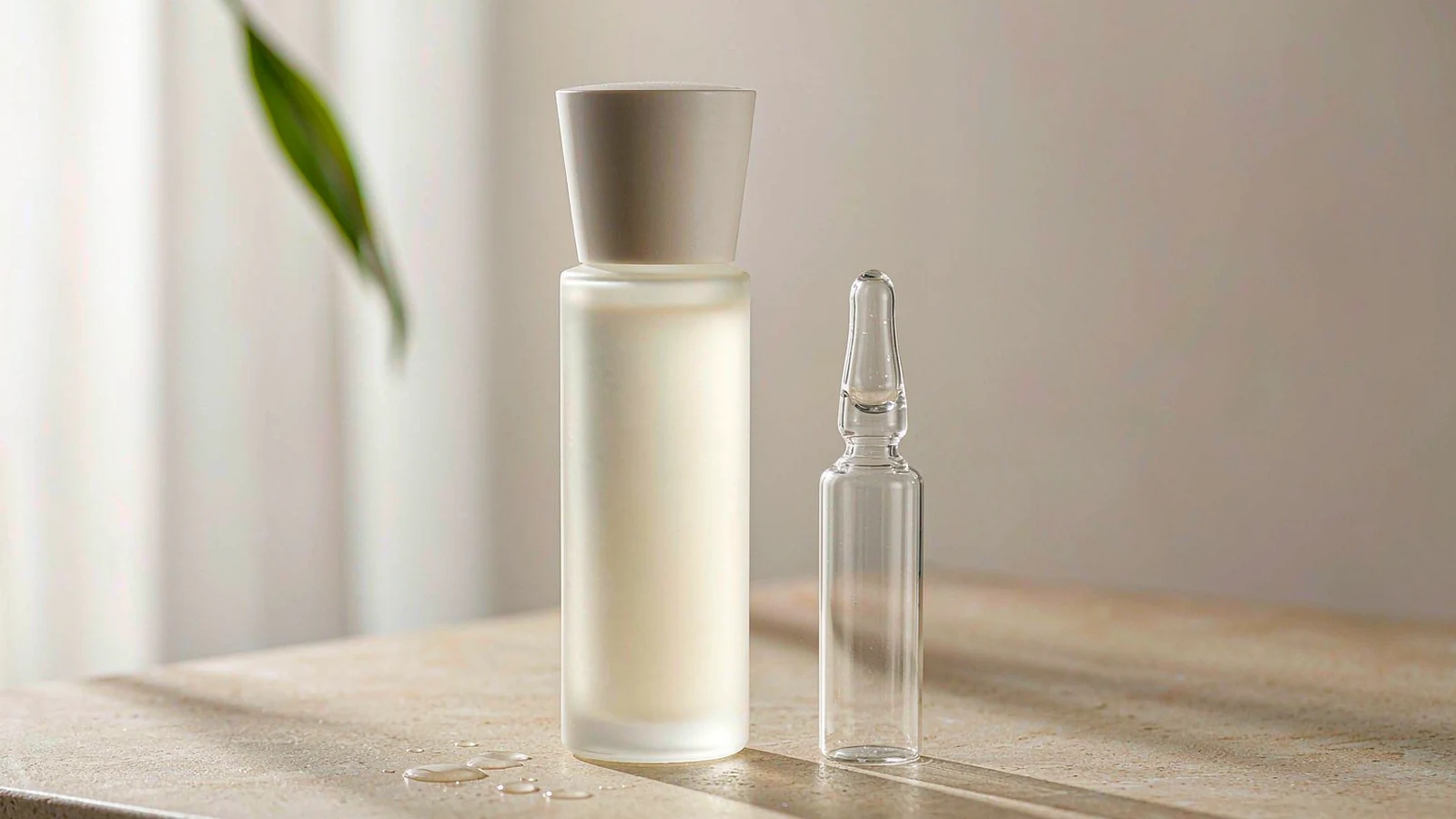
Where Korean Skincare Texture Actually Comes From
The "K-beauty" look is rarely a single ingredient. It is a set of texture decisions — water-thin toners, viscous ampoules, low-pH cleansers that still foam — repeated across a routine so the layers stack without pilling. When a brand brief arrives at a private label skincare factory, those decisions have to be translated into viscosity, pH, humectant load and fill weight before anything is mixed. This guide covers the parameters that decide whether a Korean-style routine feels right on the shelf, and what to ask before ordering.
OEM, ODM and Private Label: Three Different Deals
The words are used loosely online, but they describe different ownership. In OEM, the customer owns the formula and the factory produces it. In ODM, the factory develops the formula and licenses it, often with an exclusivity window. Private label normally means a stock formula, existing packaging and a brand label. For Korean-style ranges the ODM route is common because texture development — the hard part — sits with the lab. A serious korean skincare manufacturer private label programme should state in writing which of the three applies, who holds the formula, and what happens to that formula if the relationship ends.
Essence Toners: Water-Thin but Not Water
An essence toner usually sits under 500 cps, close enough to water that a viscosity reading is almost meaningless. The difficulty is not thickness but clarity: lipophilic actives such as tocopherol, squalane or oil-soluble extracts need a solubiliser, typically polysorbate 20 or PEG-60 hydrogenated castor oil at 0.5–2.0%, matched to the oil's HLB requirement. Under-solubilise and the batch hazes within days; over-solubilise and the product foams on the cotton pad and feels slippery. Alcohol-free versions need a glycol and a chelator to stay bright, and the whole system has to be filtered before filling.
Ampoules and Serums: The Stickiness Ceiling
Ampoules push humectants hard — 20–40% butylene glycol, or 5–10% glycerin with betaine — because the marketing story is hydration. The limit is sensory: above a certain load the residue turns tacky, drag increases, and the next layer balls up. The practical fix is a blend of humectants with different molecular weights plus a light elastomer or a small amount of dimethicone, and a viscosity target between roughly 1,000 and 5,000 cps so a 30 ml dropper draws cleanly. Fill accuracy matters more on a dropper than a pump: a 2% deviation shows as a short fill.
Low-pH Cleansers That Still Foam
Korean cleansers are often specified at pH 5.0–6.0, which rules out soap-based systems entirely. Amino acid surfactants such as sodium cocoyl glycinate or potassium cocoyl glycinate carry the foam, usually supported by a glucoside for flash foam and a betaine for mildness. The trap is the salt curve: viscosity responds sharply to electrolyte and to pH, so a small citric acid adjustment to hit pH 5.5 can drop viscosity by half. The formula is normally built around a target viscosity band and then pH-adjusted in small increments with a re-check after 24 hours.
Drying Time Is a Specification
The multi-layer routine — five or seven thin applications — only works if each layer dries fast and leaves almost nothing behind. That makes drying time and residue measurable specs, not preferences. A useful brief states the target: fully absorbed within 60–90 seconds, no visible film, no pilling when a cream is applied over it. Gums and high-molecular hyaluronate slow absorption considerably; a light carbomer or an acrylate thickener gives body without the tack. Testing on skin, not only on a viscometer, separates a workable essence from a sticky one.
Preservation at pH 5.5: What Actually Holds
Organic acid preservatives such as sodium benzoate and potassium sorbate are only effective in their undissociated form, which means a pH below about 5. This is why low-pH products cannot rely on them at 5.5. The usual route is phenoxyethanol with ethylhexylglycerin, or 1,2-hexanediol with a chelator, each chosen for compatibility with the surfactant system. Whatever the choice, the brief should name the challenge test method — ISO 11930 is the reference most importers recognise — and require the report before bulk release rather than after.
Twelve Weeks, Three Temperatures, One Verdict
Texture drift is the most common failure in this category. A toner that is crystal clear at week zero can ring the bottle by week eight; an ampoule can thin out as its thickener hydrolyses. Standard practice is 12 weeks at 40°C and 75% relative humidity alongside room-temperature controls, plus three freeze-thaw cycles between -10°C and 25°C and a centrifuge spin for emulsion stability. Packaging is part of the test: dropper bulbs plasticise, airless pumps lose prime, and anodised collars can react. Compatibility is checked with the finished product in the final pack.
Filling 30 ml Droppers in a Cleanroom
Our Guangzhou Huadu plant runs 10,000 m² with a 100,000-class cleanroom and more than 50 filling lines, which is what makes small dropper and ampoule runs practical rather than theoretical. Water-thin products need a different filler setup from creams: positive displacement or mass-flow filling, degassed bulk, and a hold time short enough that the batch does not separate in the hopper. Each batch carries a fill-weight record and a retained sample held for the shelf-life period.
MOQ, Sampling and the Calendar
For brands testing a Korean-style range, the economics are usually the deciding factor. Stock formulas in our library of more than 10,000 start at 1,000 pcs per SKU; custom packaging moves that to 3,000+. Sampling runs 7–10 days per round, and most texture work needs two rounds — one to establish the base, one to adjust sensory targets. Bulk production then takes 25–35 days after approval and component arrival. Working the launch date back from the sampling rounds, not the bulk lead time, is where most first orders slip.
Documents Your Importer Will Ask For
Exporting a Korean-positioned line into the EU, US or Gulf means paperwork that has nothing to do with texture. A skincare brand needs a Cosmetic Product Safety Report, a CPNP notification for the EU, FDA establishment registration for the US, and Halal certification where the market requires it. Our documentation team prepares these alongside the batch file, and the plant holds GMPC, ISO 22716 and ISO 9001. Before you buy into a new market, confirm which of these the importer will request; retrofitting a safety assessment onto a finished formula wastes weeks.
Choosing an OEM Skincare Manufacturer for This Category
Ask for the texture spec, not the brochure. A credible OEM skincare manufacturer will show you a viscosity band, a pH window, a preservation rationale and a stability protocol for the exact product you are buying, and will tell you which parameters are fixed and which can be tuned. It also helps to see the same formula made twice, months apart, to judge batch-to-batch consistency. If you are weighing an odm korean cosmetics supplier against a domestic one, compare the sampling rounds and the documentation package rather than the quoted unit price alone — those two items usually decide whether the launch lands on time.
A Realistic First Range
Three SKUs is enough to test a Korean-style concept: one essence toner, one ampoule, one low-pH cleanser. They share a preservation philosophy, a pH band and often a single bottle family, which keeps tooling and MOQ manageable while still reading as a routine. From there, skincare products such as sheet masks or emulsions can follow once sell-through is known. The brands that scale in this category tend to start narrow, prove the texture on real users, and only then widen the range.
We invite you to explore our capabilities and discuss your next product line.
You can reach us directly via WhatsApp +86 18924103061
Email laeyo@cosmeticoemlab.com
Website https://cosmeticoemlab.com/